
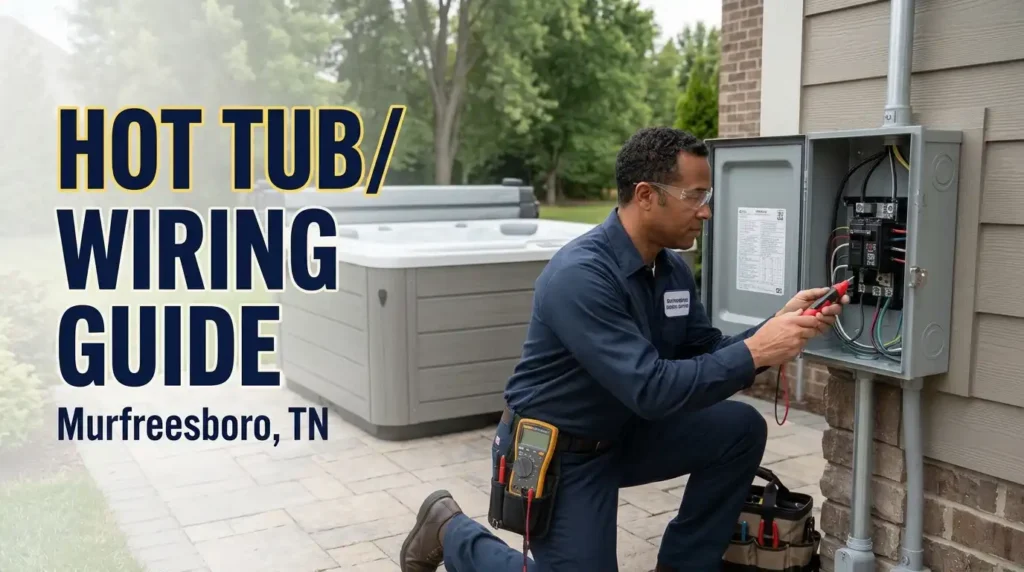
Hiring a licensed electrician for hot tub Murfreesboro TN installations means getting a dedicated 240V circuit sized correctly for your spa, GFCI protection, a disconnect within sight of the unit, and equipotential bonding of every metal component. Rutherford County and City of Murfreesboro permits are required for new spa circuits, and inspections are staged before the deck pour and again at final trim. Skipping any of these steps risks code violations, nuisance trips, and real shock hazards.
Key Takeaways
- A compliant hot tub installation in Murfreesboro requires NEC Article 680 compliance, a dedicated 50A or 60A circuit, GFCI protection, and bonding of all metal parts within 5 feet of the spa.
- City of Murfreesboro and Rutherford County both require permits and staged inspections for hot tub electrical work, and only a licensed electrical contractor can pull them.
- Middle Tennessee’s humidity and clay soil create unique wiring challenges, including nuisance GFCI trips and voltage drop on long conductor runs, that a residential electrician for hot tub Murfreesboro TN knows how to design around.
Why Hot Tub Wiring Demands a Licensed Electrician in Murfreesboro
Hot tub wiring sits at the intersection of water and electricity, which is exactly why the National Electrical Code treats it as a specialized category. A single mis-sized circuit or missing bond wire turns a backyard relaxation feature into a serious shock hazard. At Murfreesboro TN Electrician, we connect homeowners with licensed technicians who understand that a spa installation is not the same job as wiring a ceiling fan or adding an outlet.
Rutherford County’s mix of older homes near the square and newer subdivisions out toward Blackman and Rockvale means panel capacity varies widely from house to house. Some homes built before 2000 simply weren’t designed to carry an additional 50A or 60A load. An electrician for hot tub Murfreesboro TN homeowners trust will start with a load calculation, not a guess, before running a single wire.
Licensing also matters because the City of Murfreesboro requires permitted electrical work to be performed by a licensed contractor, not a handyman or the spa dealer’s installation crew. Our technicians inspect existing service capacity, confirm code compliance, and coordinate every inspection milestone so homeowners aren’t left managing paperwork on top of a backyard project. If you’re also considering a panel upgrade or other home electrical project, it often makes sense to handle both at once.
NEC Article 680: The Code That Governs Every Hot Tub Install
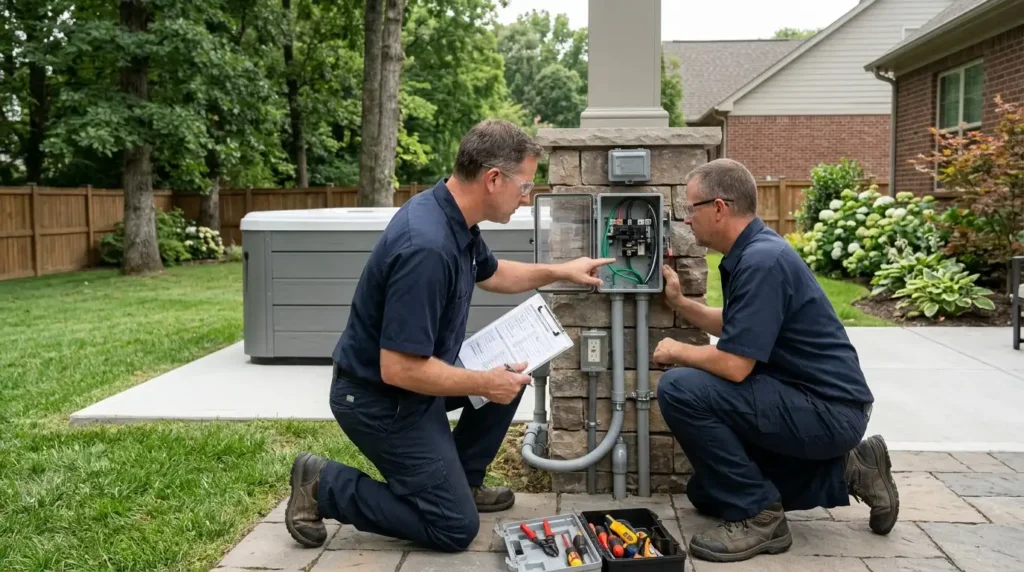
NEC Article 680 is the section of the National Electrical Code that specifically regulates swimming pools, spas, and hot tubs. It exists because water dramatically increases the danger of electric shock, so the code imposes stricter clearance, bonding, and GFCI rules than apply to ordinary household circuits.
The full code is published and maintained by the National Fire Protection Association, and local jurisdictions like Rutherford County adopt it as the enforceable standard for permitted work. Compliance with Article 680 is not optional for any hot tub connected to a dedicated circuit, whether the spa is plug-in or hardwired.
Key NEC 680 Requirements Table
| Requirement | NEC 680 Rule | Why It Matters |
|---|---|---|
| GFCI protection | All spa circuits must be GFCI-protected | Prevents shock from ground faults in wet conditions |
| Disconnect location | Within 5 feet of spa, in sight of it | Allows emergency shutoff without leaving the unit unattended |
| Receptacle clearance | 6 to 20 feet from spa/pool edge | Keeps outlets a safe distance from splash zones |
| No outlets within 6 feet | Prohibited inside the 6-foot radius | Eliminates the highest-risk shock zone |
| Equipotential bonding | Bare copper conductor connecting metal parts | Equalizes voltage across all surfaces near the spa |
| Conduit and burial depth | Varies by wiring method | Protects buried conductors from damage and moisture |
Understanding this table is the first step. Applying it correctly to your specific spa model and yard layout is where a licensed electrician earns their fee.
Also Chek – Holly Electric Murfreesboro TN: What Every Homeowner Must Know
Hot Tub Electrical Load Ratings and Circuit Requirements
Most 240V hot tubs need a dedicated 50A or 60A circuit protected by a GFCI breaker. The exact amperage depends on the spa’s heater size, pump count, and any add-on features like jets or lighting packages. Guessing at circuit size, or reusing an existing circuit, is one of the most common mistakes we find on service calls.
Table: Plug-in vs. Hardwired Spa Comparison
| Feature | Plug-in Spa | Hardwired Spa |
|---|---|---|
| Typical amperage | 15A or 20A, 120V | 50A or 60A, 240V |
| Circuit type | Standard GFCI outlet | Dedicated GFCI breaker circuit |
| Heating speed | Slower, limited by lower amperage | Faster, full-power heating |
| Installation complexity | Lower, often DIY-friendly | Requires licensed electrician |
| Best suited for | Portable, inflatable spas | Permanent in-ground or built-in spas |
Table: Circuit Size by Hot Tub Type
| Hot Tub Type | Recommended Circuit | Breaker Type |
|---|---|---|
| Small 2-person plug-in spa | 20A, 120V | Standard GFCI |
| Mid-size 4-6 person hardwired spa | 50A, 240V | GFCI breaker |
| Large 6-8 person spa with full jet package | 60A, 240V | GFCI breaker |
| Swim spa or combination pool/spa | 60A or higher, confirmed by load calc | GFCI breaker |
A load calculation must be performed before install, not after the spa arrives. Conductors must also be sized for the actual run length, not just the breaker rating, because voltage drop becomes a real issue on runs of 90 to 120 feet or more, which is common in larger Rutherford County lots.
Equipotential Bonding: What It Is and Why It Matters
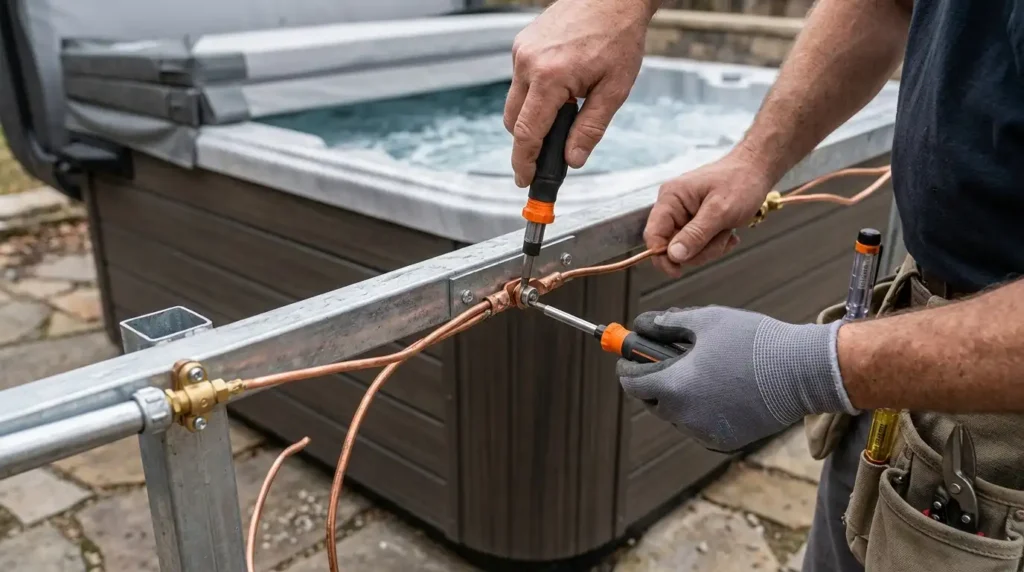
Equipotential bonding is the process of connecting all metal components near a hot tub (the pump housing, metal ladder, surrounding deck hardware, and conduit) with a bare copper conductor so they share the same electrical potential. Without this bond, a small voltage difference between two metal surfaces can send current through anyone touching both at once.
NEC 680 requires this bonding grid to be installed and inspected before any concrete or decking covers it. This is why staged inspections exist: once the deck is poured, the bonding grid is hidden from view, and a failed or missing bond becomes nearly impossible to verify without demolition.
Our technicians bond every metal part within the code-required zone, including the spa’s equipment, metal fittings, and any metal within 5 feet of the inside wall of the spa. If you’re planning a full backyard remodel alongside the spa install, it’s worth reviewing our full list of residential electrical services so bonding and other related work can be scheduled together.
The Hot Tub Wiring Installation Process (Step-by-Step)
- Perform a load calculation. Confirm the spa’s amperage draw and compare it against your panel’s existing capacity.
- Determine the circuit route. Plan the shortest reasonable path from the panel to the spa location to minimize voltage drop.
- Install the dedicated GFCI breaker circuit. Size conductors for both the breaker rating and the actual run length.
- Set the disconnect. Mount it within 5 feet of the spa and within direct sight of the unit, per NEC 680.
- Install the equipotential bonding grid. Connect all required metal components with a bare copper conductor before any concrete or decking is poured.
- Schedule the rough-in inspection. The bonding grid must be inspected before it’s covered.
- Complete final trim and testing. Connect the spa, test GFCI function, and confirm proper operation before covering any remaining conduit.
- Schedule the final inspection. This confirms the full installation meets both City of Murfreesboro and Rutherford County requirements.
Murfreesboro Permit Requirements for Hot Tub Electrical Work
A permit is required for hot tub electrical work inside Murfreesboro city limits, and it must be pulled by a licensed electrical contractor. City permits are issued through the City of Murfreesboro Building and Codes Department at 111 W Vine St, while homes outside city limits fall under the Rutherford County Building Codes office at 1 S Public Square, Suite 201.
Both jurisdictions require staged inspections: one for the bonding grid before any deck pour or concrete work covers it, and a final inspection once the installation is complete. Skipping the permit doesn’t just risk a fine — it can also void homeowner’s insurance coverage if an electrical fire or injury occurs later and the work is found to be unpermitted.
Hot Tub Wiring Cost Breakdown for Rutherford County Homeowners
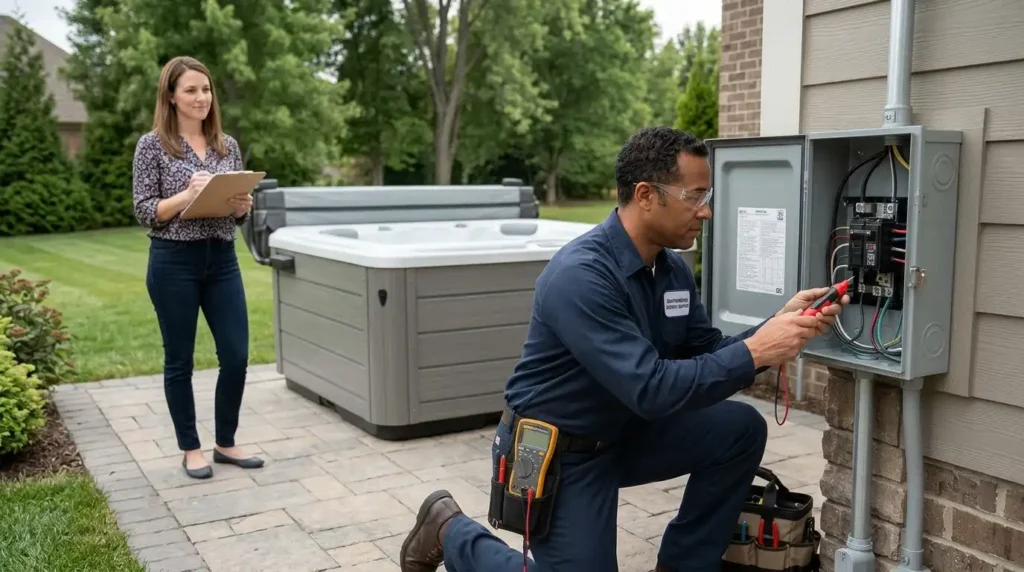
Cost depends heavily on how far the spa sits from the main panel, whether a panel upgrade is needed, and the complexity of the bonding work required.
Table: Cost Comparison by Scope of Work
| Scope of Work | What’s Included | Relative Cost |
|---|---|---|
| Short-run dedicated circuit | New 50A/60A circuit, disconnect, GFCI breaker, under 50 ft run | Lower |
| Long-run dedicated circuit | Same as above, plus upsized conductors for 90-120+ ft runs | Moderate |
| Bonding grid installation | Bare copper bonding of all metal components, inspected before deck pour | Moderate |
| Panel upgrade plus spa circuit | New panel to support added 50A/60A load, plus full spa circuit | Higher |
| Full install with permits and both inspections | All of the above, plus permit fees and staged inspections | Highest |
Getting a firm number requires an on-site assessment, since run length, soil conditions, and existing panel capacity all shift the final price.
Common Hot Tub Wiring Problems We Find on Service Calls
- Spas plugged into a standard outlet instead of a dedicated GFCI circuit
- Disconnects installed more than 5 feet from the spa, or out of sight of it
- Missing or incomplete equipotential bonding grids
- Undersized conductors on long runs, causing voltage drop and heater underperformance
- Buried cable without proper conduit, especially in Middle Tennessee’s clay soil, which holds water against the cable and accelerates corrosion
- GFCI breakers that trip repeatedly due to humidity intrusion in connections
- Circuits that were never permitted or inspected, discovered during a home sale
GFCI Breaker Keeps Tripping: Troubleshooting Checklist
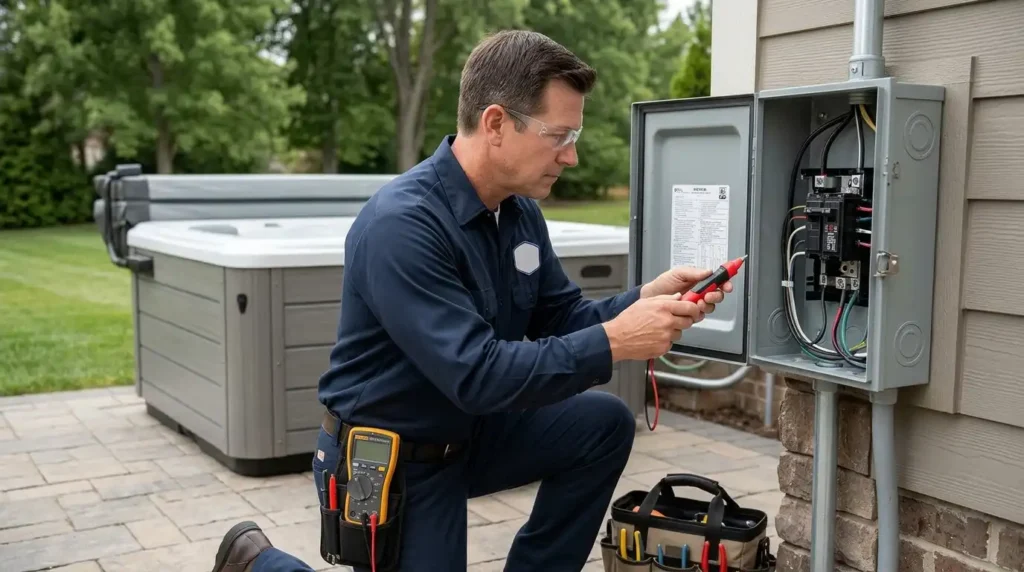
- Check for recent rain or humidity spikes. Middle Tennessee’s humid summers are a leading cause of nuisance GFCI trips.
- Inspect the disconnect box for moisture intrusion. Look for condensation or water pooling inside the enclosure.
- Test the GFCI breaker itself. A worn breaker can trip even when the circuit is functioning normally.
- Check conductor connections at the spa’s equipment compartment. Loose or corroded connections cause ground faults that trip the breaker.
- Verify the bonding grid is intact. A broken bond can create a nuisance fault condition.
- Confirm the spa’s heater and pump aren’t drawing more current than the circuit allows. An undersized circuit will trip under load.
- Call a licensed electrician if trips continue. Persistent tripping after these checks usually points to a wiring fault that needs professional diagnosis.
Panel Upgrade Considerations Before Installing a Hot Tub
Adding a 50A or 60A dedicated circuit is a meaningful new load, and older panels in Rutherford County, particularly those in homes built before the 1990s, often don’t have the spare capacity to support it safely. A load calculation will reveal whether your existing panel can handle the addition or whether a panel upgrade needs to happen first.
This is also a good moment to think about overall home electrical capacity, especially if you’re planning other additions like an EV charger or a generator down the road. Reviewing our panel and wiring services before the spa arrives can save a second service call later. Upgrading now, rather than reactively after a tripped main breaker, also supports broader energy efficiency goals outlined by ENERGY STAR, since a properly sized panel runs more efficiently under added load.
Hot Tub Wiring Safety Checklist for Murfreesboro Homeowners
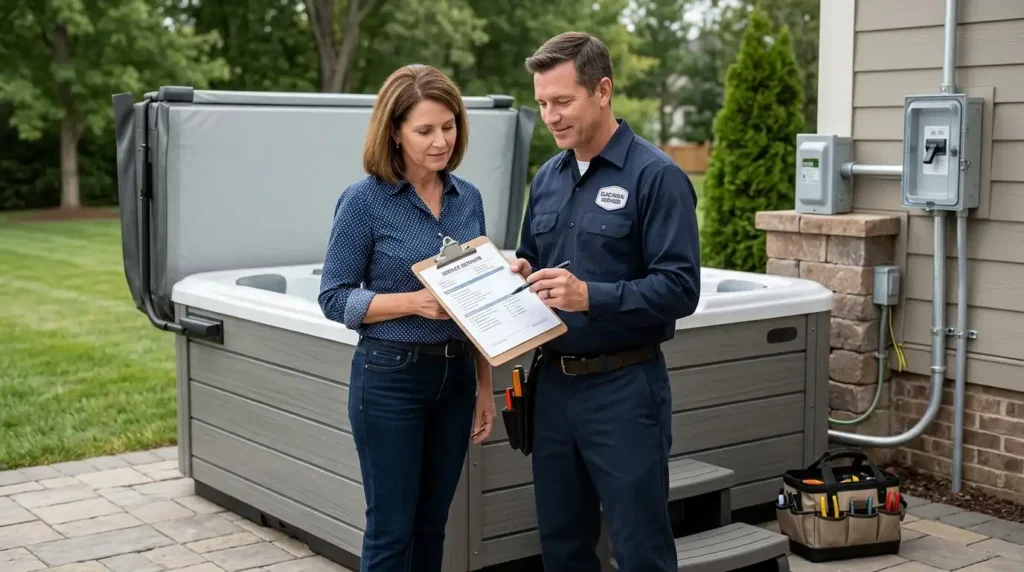
- Confirm the circuit is dedicated and GFCI-protected
- Verify the disconnect is within 5 feet of the spa and visible from it
- Check that no outlets exist within 6 feet of the spa’s edge
- Confirm all metal components are bonded with bare copper conductor
- Verify permits were pulled and both inspections were completed
- Inspect buried conduit depth if cable runs underground
- Test GFCI function monthly, especially during humid summer months
- Keep spa equipment compartments free of standing water
Service Areas: Where We Provide Hot Tub Electrical Services
Murfreesboro TN Electrician connects homeowners across Rutherford County and the surrounding Middle Tennessee region with licensed technicians experienced in NEC 680-compliant spa installations. Coverage extends to communities including Smyrna, La Vergne, and Eagleville, along with towns further out across Williamson, Wilson, and Davidson counties. A full list of covered communities, along with what matters for local homes in each one, is available on our service areas page. If you’re searching for a residential electrician for hot tub Murfreesboro TN near me, calling is the fastest way to confirm which licensed providers serve your specific address.
Faqs:
1. Do I need a permit for a hot tub in Murfreesboro TN?
Yes. Any new dedicated electrical circuit for a hot tub requires a permit from either the City of Murfreesboro Building and Codes Department or Rutherford County Building Codes, depending on your address, along with staged inspections before the deck pour and at final trim.
2. Can I plug a hot tub into a regular outlet?
Only small, low-amperage plug-in spas rated for 120V and 15A or 20A can use a standard GFCI-protected outlet. Larger hardwired spas require a dedicated 50A or 60A circuit and cannot be safely connected to a standard household outlet.
3. What size circuit does a hot tub need?
Most 240V hot tubs need a dedicated 50A or 60A circuit with a GFCI breaker, though the exact size depends on the spa’s heater, pump count, and feature package. A load calculation determines the precise requirement for your specific spa model.
4. How far can the panel be from the hot tub?
There’s no strict maximum distance in the code, but longer runs of 90 to 120 feet or more introduce voltage drop that can affect heater and pump performance. Conductors must be sized for the actual run length, not just the breaker rating, to compensate for this.
5. Why does my GFCI breaker keep tripping?
Humidity intrusion into the disconnect or equipment compartment is the most common cause in Middle Tennessee’s climate, followed by loose connections, a worn breaker, or a compromised bonding grid. Persistent tripping after basic checks usually indicates a wiring fault that needs professional diagnosis.
6. Get Your Hot Tub Wired Right the First Time
A hot tub should be a source of relaxation, not a recurring electrical headache or a safety risk hiding behind a deck board. Working with a licensed electrician for hot tub Murfreesboro TN installations means your circuit is sized correctly, your bonding grid passes inspection before it’s covered, and your GFCI breaker holds up through another humid Tennessee summer.
Call Murfreesboro TN Electrician to connect with a local, independent provider who can assess your panel, plan your circuit, and handle every permit and inspection along the way. Visit MurfreesboroTNElectrician.com to get started.
Frequently asked questions
For work that involves new wiring, panel work, structural support, old wiring, or uncertainty about safety, connecting with a licensed electrician is the safer choice.
No. The guide is educational. An electrician needs to see the actual wiring, equipment and installation to give advice for a specific home.