
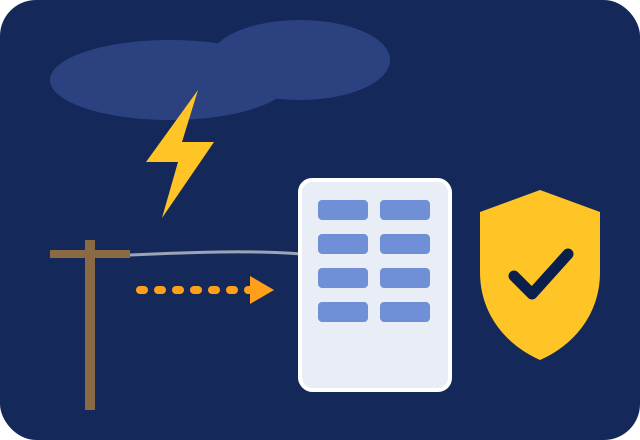
It is a practical upgrade for Middle Tennessee homes, where thunderstorms are frequent. Calling connects you with a local electrician who can look at your panel and grounding and explain what surge protector installation would involve for your house.
What a panel-mounted protector does, and what it doesn't
Surges come from outside and inside. Lightning nearby, utility switching and storm-related line faults create large external spikes. Inside the home, motors in AC units, refrigerators and pumps create smaller, frequent spikes when they cycle. A whole-house device diverts excess voltage to ground, which is why a solid grounding system matters so much for it to work.
It is not lightning protection in the full sense. A direct strike to a house is a separate problem handled by a lightning rod system, which is outside the scope of a surge device. The practical approach is layered: a whole-house device at the panel, plus quality plug-in protectors at sensitive electronics like computers and TVs, and protection on incoming cable, phone or antenna lines where possible.
When surge protection is worth adding
- After a storm has damaged appliances, electronics or HVAC controls
- When installing a new heat pump, generator or EV charger
- During a panel upgrade, when it is simple to add
- In homes with expensive home office or entertainment equipment
- On rural properties with long overhead lines and more storm exposure
Clues your home is seeing surges
- Electronics or chargers failing sooner than they should
- Appliance control boards that fail after storms
- GFCIs or AFCIs that trip during thunderstorms
- Clocks on appliances resetting when nothing seemed to happen
- Lights that flash brighter for a moment when big motors cycle
How installation usually works
Most whole-house surge devices mount on or inside the panel and connect to a dedicated two-pole breaker, or to the service conductors on some types. Short, straight leads matter, since long wire runs reduce how well the device clamps a surge. The electrician also checks the grounding electrode system and bonding, because a protector cannot shunt a surge to ground effectively if the ground connection is weak. Many devices have indicator lights that show when they are working and when they need replacement.
- Panel space and a suitable breaker for the device
- Grounding electrode conductor and ground rod connections
- Bonding of water and gas piping where required
- Lead length between the device and the panel bus
- Whether coax, phone or data lines enter with proper grounding
- Status indicators after installation
Safety first. During a close thunderstorm, the simplest protection is to unplug sensitive electronics you are not using. Do not open the panel to check on a surge device yourself; its indicator lights are designed to be seen through the cover or on the front. After a nearby lightning strike, check for a burning smell and inspect outdoor equipment from a distance. See storm and lightning damage for what to look for.
How it usually works
Call to talk it over
The call connects you with a local electrician. Mention any storm damage and what equipment you want protected.
Look at the panel and grounding
The electrician checks panel space and the grounding system the device depends on.
Installation
The device is installed with short leads, connected to its breaker, and checked for proper function.
Plan the layers
You get advice on point-of-use protectors and incoming cable or phone lines.
In Murfreesboro and Middle Tennessee homes
Middle Tennessee spring and fall storms bring plenty of lightning, and power flickers and outages during storms are part of life around Murfreesboro. Heat pumps, which many homes here use, rely on sensitive control boards that are expensive to replace. Rural properties with long overhead service lines and outbuildings tend to see more storm exposure. If you are also thinking about backup power, whole-home generator installation and surge protection are often planned together. The storm season prep guide covers other steps.
Related electrical problems
Seeing one of these at home? Each guide explains likely causes and what's safe to check before you call about surge protection.